
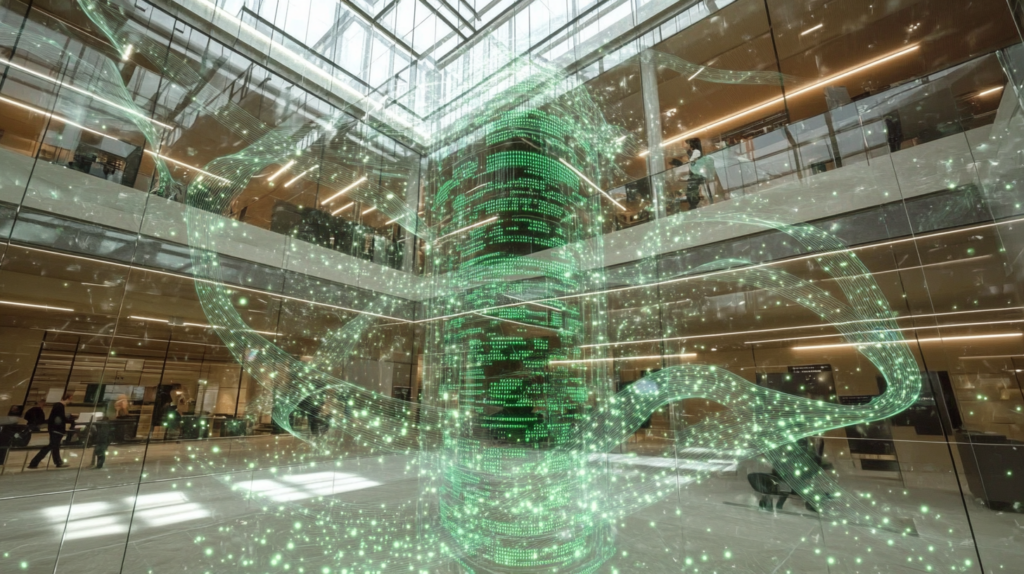
When the company stops being a sum of processes and starts behaving like a living system
Why linear models no longer explain business reality and how the concept of the company-as-system is born
Most organizations still describe themselves as a collection of processes. This approach worked for decades in stable environments, where operations could be represented through production lines, rigid workflows, and predefined rules. But that world no longer exists. Today, the company operates in a dynamic, uncertain environment full of interactions that no linear process can capture.
The conceptual leap that has yet to become widespread is understanding that a company does not function like a machine, but like a living system: adaptive, social, and subject to constant variability.
Why linear models no longer scale
Processes are useful, but insufficient. They describe ideal paths, not operational reality. In practice, any process is affected by exceptions, human decisions, shifting priorities, external events, supplier dependencies, resource availability, regulations, and demand fluctuations.
Classic BPM models assume that flow is stable and that all cases are similar. This no longer holds. The current diversity of products, services, and channels multiplies the possible configurations. Variability ceases to be a deviation and becomes the norm.
In this context, linearity breaks down through saturation. The more you try to detail a process to cover exceptions, the more complex and fragile it becomes. The result is a paradox familiar to any executive: more definition does not mean more control. In many cases, it means the opposite.
The human factor, uncertainty, and context
The operation of a real company depends on people, and people do not follow perfect flows. They interpret, prioritize, correct, improvise, and adapt decisions based on context. That human capacity is valuable, but it also introduces a variability that traditional systems are not designed to handle.
Furthermore, the company does not operate in isolation. Its functioning depends on external actors — suppliers, customers, regulators, subsidiaries, partners — who influence internal behavior. An organization may have flawless processes, but a single supplier delay or regulatory change is enough to destabilize the entire model.
Current approaches, based on automating tasks or integrating applications, do not capture this socio-technical complexity. We need a framework that represents how all elements of the system interact, not just how a process flows.
The birth of the company-as-system concept
A company-as-system:
- represents processes, but also rules, actors, events, and decisions;
- understands dependencies and priorities;
- incorporates context and variability;
- evolves as the organization evolves;
- and maintains a unified view of operations.
This model does not replace existing tools, but reorganizes them under a common logic. It allows us to understand how the company actually works, beyond the diagram of its processes.
Variability is no longer an anomaly, but a structural condition. Customized products, multiple configurations, diverse suppliers, changing regulations, and customers with immediate expectations generate a complexity that traditional models cannot absorb.
Attempting to govern this environment with rigid applications and linear processes inevitably leads to higher costs and less control.
The company as a living system
When we adopt this perspective, the organization ceases to be a set of workflows and becomes a dynamic ecosystem. In a living system:
- relationships matter more than functions,
- interactions change the state of the whole,
- local decisions produce global effects,
- and continuous adaptation is a structural necessity.
Companies that operate with this understanding achieve greater coherence between strategy and execution, reduce friction, and make informed decisions in real time.
But to connect this vision with technology, a tool capable of representing, interpreting, and executing this living system is needed.
This is why, as business becomes more dynamic, technology stops being an enabler and becomes a bottleneck.
This is where many companies unknowingly hit their digital maturity ceiling.
The Organizational Digital Twin emerges
The Organizational Digital Twin (ODT) is the first technology designed to reflect this company-as-system in its full depth. It does not replicate machines or simulate ideal processes: it represents the real behavior of the organization and cooperates with it.
An ODT:
- interprets rules and decisions,
- integrates all actors in the ecosystem,
- handles exceptions and variability,
- learns from real-world operations,
- and acts as a living reflection of the system, not merely as an observer.
It is, in essence, the digital manifestation of the company-as-system.
That is why its impact is not technological, but organizational: it offers an operating model that adapts to the real complexity of the business.
A conclusion for senior leadership
The question is no longer “how do we optimize processes?“, but:
“Do we have a model that represents how our company actually works?”
If the answer is no, the organization is operating below its potential.